Showing posts with label AS Religious Studies - Philiosphy of Religion. Show all posts

Monday, 11 January 2010

The Moral Argument by Kant and criticisms by Freud

This is a video of me below explaining the moral argument and its criticisms:


  • It is an a-posteriori argument.
  • The argument starts from our experience of morality (right and wrong) and concludes that God must exist to explain this fully.
  • Kant didn't believe the argument proved God's existence. Rather, Kant said it was reasonable to postulate God in order to make final sense of reality.
  • It is based on three assumptions:
                (i)  We are free to do both right and wrong.
               (ii)  God will reward the person that lives dutifully.
               (iii) There us an after-life to make this possible.

So here is how it goes...

  1. People who are good should be happy.However, this is not always true. Some good people are very unhappy because life treats them badly.
  2. There must be something else which makes them act morally. This is the highest good or what Kant call 'Summum bonum' and their sense of duty to achieve the highest good.
  3. Our 'reason' tells us which laws should be obeyed; these are laws that can universalised.For example, we know stealing is wrong because if everyone went around stealing, society would fail.They are called categorical imperatives; non-negotiable and absolute requirements fulfilling their duty.
  4. There must be a reward for our moral behaviour in the next world- the summum bonum.
  5. Hence,  it is reasonable to believe God exists as he is entity that promises to reward us.
Sigmund Freud's criticisms

  • He believed our sense of duty and moral awareness can be explained by socialisation i.e. the adaptation of behavioural patterns of the surrounding culture.
  • He said our conscious (decisions to do right or wrong) was a product of our unconscious mind or super-ego of he human psyche.
There are 3 parts to the human psyche...
  1. ID- Basic instincts and primitive desires e.g. hunger, lust, greed etc.
  2. Ego- Perception of the external world that makes us aware of the 'reality principle'. It is one's most outward part and personality.
  3. Super-ego - This is the unconscious mind which consists of: (i) the ego ideal: this praises all good actions and (ii) conscious who makes you feel guilty for bad actions.
  • For Freud, moral awareness cannot derive from a divine origin because then the commands would be absolute and we all would come to the same conclusion. For example; in the case euthanasia some find it unmoral and other find it moral (relieving loved one rom pain)
A further development on the criticism...

  • If the conscious which makes good and bad decisions is the word of God than you would expect the moral code enforced by God to be consistent.
  • However, this does not explain cases such as the Yorkshire Ripper who claimed to follow voices in his head.
  • It can be implied from that, that the conscious is not truly objective.
  • Therefore, it has a human not divine origin.


Sunday, 10 January 2010

Cosmological Argument

St. Thomas Aquinas expressed an a-posteriori Cosmological argument in 3 of his five ways: (a) The unmoved mover (b) The uncaused causer and (c) Possibility and Necessity. Later, Frank Copleston developed this argument in radio debate with Bertrand Russell. Hume also added several criticisms to the argument later.

So what was Aquinas' first way? 
The unmoved mover
  1. Everything in the world seems to be moving.
  2. Motion in an object is caused by an external force for example a car will only move if petrol is added.
  3. Furthermore, he said that every object has a potential form and an actual form e.g. a log has a potential of being a heat giver but actually it is just a log. It takes something to cause it to change into its potential form i.e. it takes a human to set it alight for it be heat giver.
  4. Aquinas rejected that these causes could go back to infinity.
  5. He said there must be something external which causes motion which it self is unmoved.
  6. This he said is the Prime Mover or the unmoved mover which we know as God.
What about the second way?
The uncaused causer- This is similar to the first way but it explores cause rather than motion.
  1. He looked at everything in world and said nothing comes about by itself. For example, my computer didn't come about by itself it required somebody to get all the bits and put it together.
  2. Again, Aquinas rejected this chain of causes could go back to infinity.
  3. He said there must of been something external which itself was uncaused.
  4. This is caused the uncaused causer which we know as God.
And the third way?
Possibility and necessity...
  1. This argument revolves around two 'assumptions' as such: (i) time is infinite and (ii) all things in this world are contingent i.e. one day these things will cease to exist.
  2. Therefore, there must have been a time when nothing was around [where all contingent things ceased to exist].
  3. Since nothing can come from nothing; there must have been a necessary being which explains why contingent things came into existence.
  4. This cause is what we know to be God.
Radio Debate Frank Copleston and Bertrand Russell
  • Copleston developed the Cosmological argument. He said that individual things on Earth do not themselves have a reason or a cause. He says reality is a compilation of these unexplained objects. Therefore, the explanation of the world must lie outside and it must be its own sufficient reason.
  • Russell responded to this saying just because individual parts of the universe require an explanation does not mean the universe itself does too. The universe has to be accepted as a brute fact. He gave a metaphor for this - he said just because individual humans have a mother it does not mean there is one mother for the whole human race.
  • To this Copleston famously replied "one cannot be checkmated if one refuses to sit at the chessboard."
David Hume's Criticisms:
  1. You can deny the argument of possibility and necessity without contradicting oneself because you can reject the concept of a necessary being all together.
  2. If the universe requires a cause then why doesn't God?
  3. Also, isn't of funny how the argument starts off with the idea of universal causation and ends up with something which is uncaused.

Sunday, 3 January 2010

Plato's allegory of the cave


The first part of the analogy...

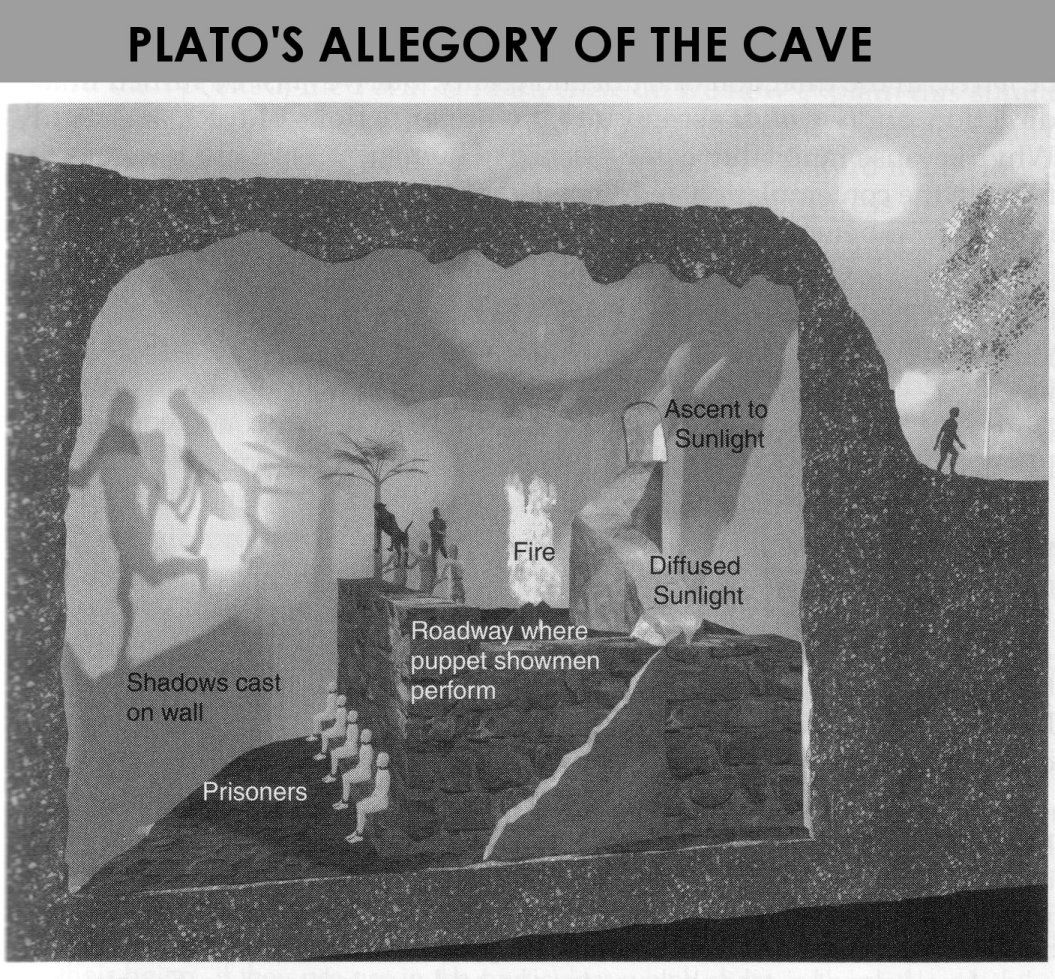
Plato used an allegory to make this concept of the world of the Forms clearer. He said if you imagine a cave with prisoners inside it. The prisoners are sitting and are chained at the neck, arm and leg so that they cannot move. Behind them puppeteers with the help of fire and puppets are creating shadows onto the wall in front of the prisoners. Obviously, the prisoners are not aware of what is happening behind them so the shadows they see in front of them they take to be reality. The cave has opening at the top where a small area of sunlight flows in, but the prisoners cannot see this either. People passing by the cave are making noises which are what the prisoners hear; unaware of the opening they take those noises to be reality and believe it is the shadows before them making these noises.

What does all of this mean?
The prisoners are representations of us. Plato is trying to communicate to us what we see as reality is nothing more than a dim-reflection of true reality.The fire represents a dim-reflection of the Form of the Good which is the true creator of reality. He is saying that if the Earth is our world then, outside the cave, outside the world we will find the world of the Forms.

The second part of the allegory...
A prisoner manages to escape and realises what he thought was reality was actually all fake - the truth is the fire and puppeteer. He is hurt by this and then he notices the opening of the cave and follows the shadow of the sun which is reflected on the stairs. Once he out of the cave he discovers noises he was hearing were actually from the world of the Forms. He sees the sun gives light and in essence life to everything. He enjoys the world. However, being a good person he decides to go back and meet his prisoner friends so he can tell them all about what he has discovered. However, they laugh at him and think he has gone mad. So he returns to true reality i.e. outside the cave.

What does this part symbolise?
According to me, the prisoner Plato describes might just be a metaphor for himself but that is just my opinion. Nevertheless, the point he is trying to get through is that even if one realises, it is hard for others to accept. The sun that the prisoner sees is the Form of the good which gives life to everything else in the world of the Forms is a metaphor for the Platonic God which is impersonal and inactive. Plato believed the body is a prisoner for the soul so he is trying to demonstrate that once we can get over what we call reality and our bodily needs we can let our soul experience true reality. This is also what happens to our soul when it dies.

Still need help?
Check this video out:


Saturday, 2 January 2010

The Irenaen Theodicy

The soul-making theodicy - Key points to remember!


  • Irenaeus too believed that evil is the consequence of human free will and disobedience although he did not take the Genesis account literally like St.Augustine.
  • Different to Augustine, he implies that God is partly responsible for evil and suffering.
  • He argued that God created an imperfect world to begin with and imperfect and immature beings so that we could develop through the soul-making process into the child of God. This allows us to grow into his likeness.
  • He says that God could not have created humans perfectly because then whether we like it or not we would have to act morally. So he gives us free-will to allow us to willingly act morally which is a much more valuable act. However, for this God must allow evil and suffering to take place. 
  • A point to remember; for Irenaeus we are made in the image of God i.e. we have free-will, intelligence, choice etc. However, we are not perfectly created because we are not created in God's likeness thus we need to develop into this.
  • Natural evil has the divine purpose to develop qualities such as compassion through the soul-making process.
  • Moral evil is a mere derivative from human free-will and disobedience.
  • Irenaeus concluded that eventually humans will develop into the perfect likeness of God and everyone will have eternal life in heaven.

Sunday, 27 December 2009

God As A Creator - Quiz questions and answers

First you have a go at some of these...
  1. What is meant by the term “Judeo-Christian tradition”?
  2. Which word, beginning with T describes God as being “beyond” or “other”?
  3. Which word beginning with I describes God as being “here with us now”?
  4. “The human brain is like a computer is an a - - - - - -. (If you’re stuck on this question look at question 10 for a clue.)
  5. Omnibenevolent means - - l l - - - - -
  6. Omniscient means - - l k - - - - - -
  7. Omnipotent means - - l p - - - - - - -
  8. In Genesis we get a picture of God as c - - - - - - -
  9. All that god makes is - - - -
  10. We use an analogy when we say that God is like a c r - - - - m - n

Answers...

  1. The tradition and beliefs that originate from the Bible; either the Old Testaments (Jewish tradition) or New Testament (Christian tradition).
  2. Transcendent
  3. Imminent 
  4. Analogy 
  5. All-Loving
  6. All-knowing
  7. All-powerful
  8. Creator
  9. Good
  10. Craftsman 

Thursday, 24 December 2009

Religion and Science

Some questions answered...
First you have a go at some of these questions...


  1. What is the difference between Young Earth Creationists and Creationists who subscribe to the "Old Earth Theory of origins"?
  2. It seems curious that among Creationists it is the Young Earth view which now prevails. How do you account for the fact that almost half of all Americans, according to the Gallup Poll, believe the Earth is less than 10,000 years old?
  3. Why does Dawkins claim that Emmanuel College (http://en.wikipedia.org/wiki/Emmanuel_City_Technology_College#Controversy) is "deliberately and wantonly misleading its pupils"? Do you agree with him?
  4. Creationists are disturbed by the notion that people are descended from apes. If you were trying to reassure them that it is entirely possible to believe both that people are "made in the image and likeness of God" and that we are descended from apes, what would you say to them?
  5. What is methodological naturalism?
  6. Why must scientists, by the very nature of what they do, not refer to God, or to any supernatural source, to explain natural phenomena?
  7. Does this mean that scientists cannot believe in God? Explain your answer.
  8. Why does Behe's bacterial flagellum argument not work in term of scientific evidence?
  9. Why do people believe literally in Genesis find Darwinism a threat to their faith?
  10. What is meant by the term "God of the gaps"?
Answers...
  1. Young Earth Creationists are those who take the Bible literally and discount  scientific evidence whereas Old Earth Creationists take the Bible more metaphorically. For example, they say a "day" in Genesis means a period of time not 24 hours.They can believe in the Creation Story as well accept the fossil records. They say that yes there are scientific laws but God can break them if He wants (through miracles).
  2. As science makes more discoveries the God of the gaps appears to be disappearing and a lot of people are starting to believe there is no God. However, many Christians find this disturbing and have started to take the Bible literally.  So now in America especially the Evangelical areas, almost half of the people believe the Earth is less than 10,00 years old. This belief originates from the Bible.
  3. Dawkins makes that claim because he feels that teaching creationism in  science lessons is deceiving. This is because creationism has no evidence as such (except for the Bible) which proves it and it has not gone through the scientific testing process. Therefore, to teach it as a scientific discipline is incorrect. I agree with this because science works through a process called methodological naturalism (http://rationalwiki.com/wiki/Methodological_naturalism) and this means that science will never face or turn in the direction towards the supernatural. Thus, I conclude that Creationism which points towards the supernatural should not be taught in science lessons; perhaps R.S lessons.
  4. I would say that God can work through science. There is nothing to stop one believing that we have come on Earth through evolution and God was the original trigger of evolution. At the end God was striving to create higher life which is made in his image i.e. us, and this could be done through evolution. 
  5. Methodological is the process by which science works. It looks to the natural world for answers and will never look towards or towards something like the supernatural as its existence cannot be proved or measured. Also, it is not part of the natural world.
  6. Suggesting a supernatural source is a 'scientific dead end', since it is simply not possible to verify by experiment the existence of such a 'supernatural source'.
  7. No, in fact they can but they must not mix up the two disciplines and keep they scientific work away from there personal beliefs in God. It is like having two different hats; you wont wear both of them together at any one given moment you wear them separately - the same way you keep religion and science different.
  8. It is all fine and well saying just look at how intricate this bacterium is but scientists cannot go further than that because how are they supposed to prove that God's hand was behind its complexity. Also, Rusty Entrekin observes that methodological naturalism encourages scientists 'to exclude anything but naturalistic explanation from science'.
  9. It is a threat for them because the Bible says that God created the world in 6 days and humans were created superior to animals. Man was given dominion of the natural world. Now, evolution is suggesting that in fact animals like apes are our ancestors and God didn't create us - it was natural process called natural selection. So slowly all the evidence from the Bible is being disproved with evidence which Christians don't have to respond to these challenges. There Darwinism is threatening their faith.
  10. The term "God of the gaps" means that for everything that science cannot explain i.e. the gaps in science is explained by God. This God is only used to explain what science cannot explain!